ALUMNI WRITING
Writers on alumni artists of our residency programme
A
C
F

G
H
I
J
K
M
P
R
S
T
V
W
Y

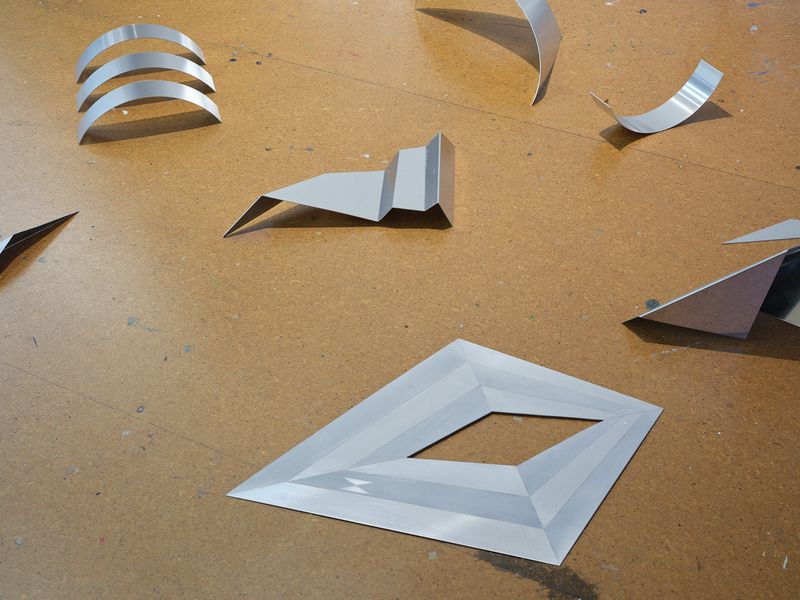
Parehuia studio during Benjamin Work's residency, works in progress, 2024
Images by Sam Hartnett
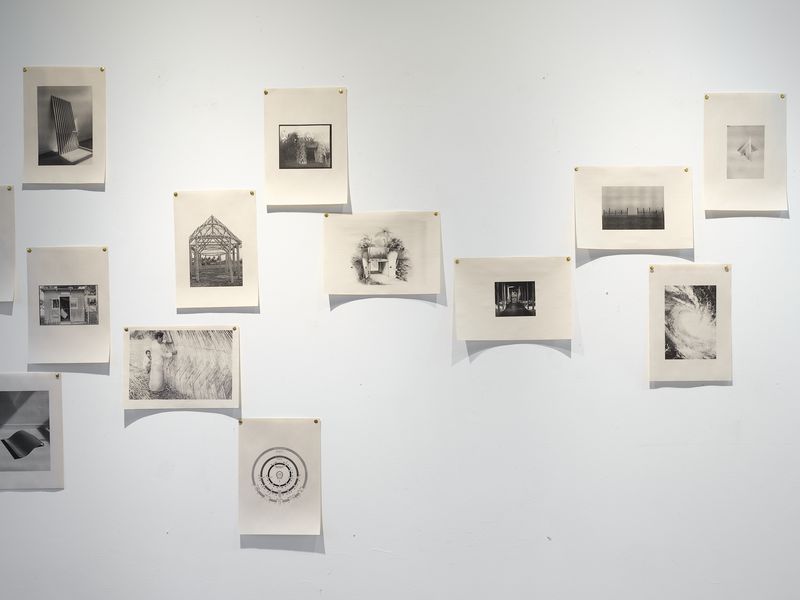
Parehuia studio during Benjamin Work's residency, works in progress, 2024
Images by Sam Hartnett
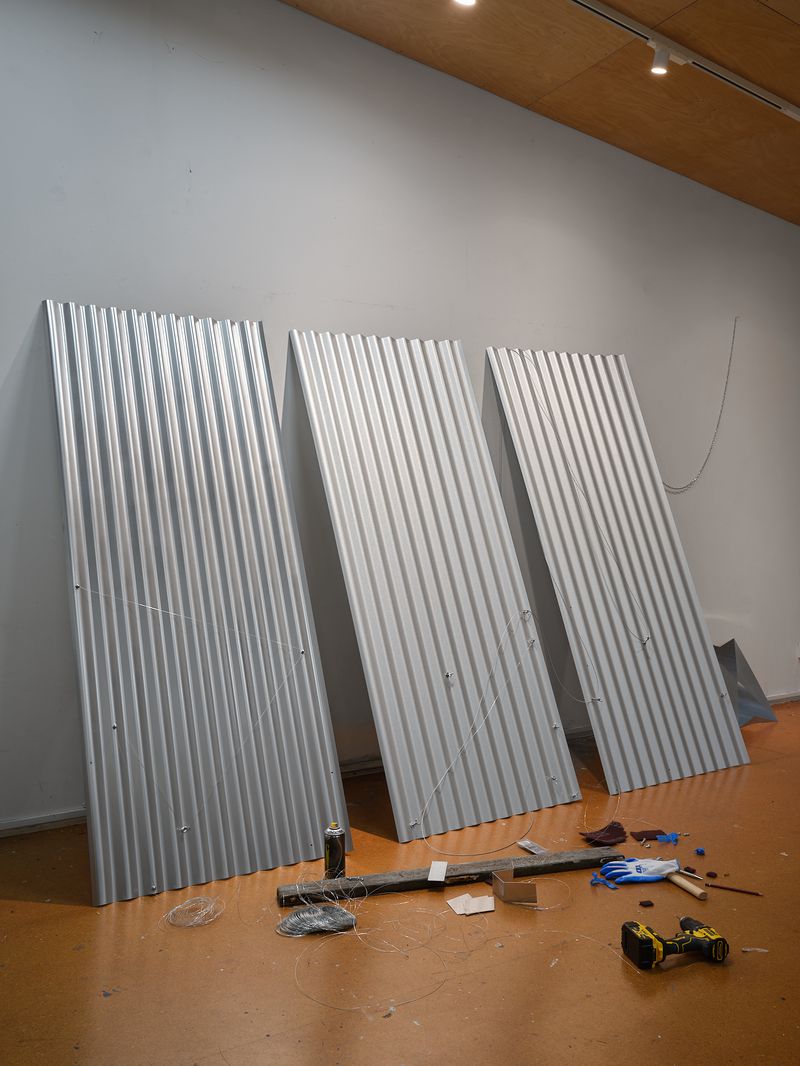
Parehuia studio during Benjamin Work's residency, works in progress, 2024
Images by Sam Hartnett
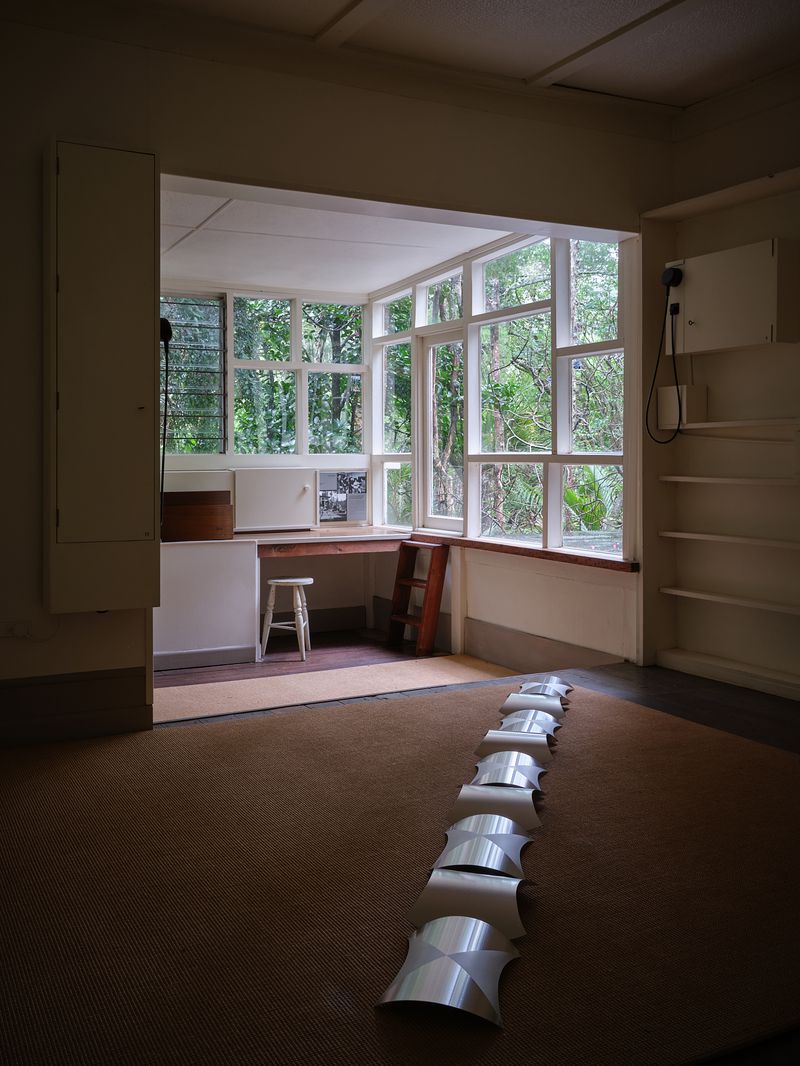
Benjamin Work's work in progress during his Parehuia residency in 2024, presented in the McCahon House Museum. Image by Sam Hartnett
Oceania denotes a sea of islands with their inhabitants. The world of our ancestors was a large sea full of places to explore, to make their homes in, to breed generations of seafarers like themselves. People raised in this environment were at home with the sea. They played in it as soon as they could walk steadily, they worked in it, they fought on it. They developed great skills for navigating their waters, and the spirit to traverse even the few large gaps that separated their island groups.1
—Epeli Hauʻofa
Arrayed about the floor of the studio at Parehuia are entities made of sheet aluminium cut into regular shapes: strips, triangles, quadrilaterals whole and punctured. Some of the shapes are bent into arcs, others are crisply folded. I am reminded of Lygia Clark’s Bichos of the early 1960s, which seem to stretch across picture and sculpture, fixity and flux. Patterns and small symbols have been etched onto the surfaces of some of the forms using steel wool. Three large sheets of corrugated steel lean against a wall, their bottom edges studded here and there with bolts and wingnuts between which are strung wires.
Thumbtacked to the walls are a series of printouts, reference images to stimulate Benjamin Work’s experimentations. Most depict people and structures from Tonga. There are engravings from early European voyages, lithographs that appear to come from missionary memoirs, nineteenth-century photographs produced for tourists or the faraway curious, more recent snapshots of everyday life. The studio is as much study space as workshop. But this is hardly surprising. Work has long placed an emphasis on research, and his McCahon residency overlaps with his MFA at the University of Auckland Waipapa Taumata Rau. Behind or within his art, there is always a plethora of histories, stories, lines of enquiry.
The pieces of paper form a constellation, or an archipelago, which I suppose is nothing if not a constellation in the sea. The aluminium entities, too, dance between star and island. Or perhaps they are waves upon the ground-ocean. Some surge upward like swells in sparkling symmetry. Others ripple as if agitated by a breeze. Still others remind me of sunlit cloud, their scrubbed surfaces seeming to glow from within. Snippets of the surrounding studio and the bush outside catch in the aluminium. The works are in the world and the world is in the works. I move in to examine one of the pieces more closely, and I too appear, hazily but decisively implicated, reflected and out of my own grasp.
In academia, a lot of study has been about us, but not from us or by us, and not for us. I’ve seen throughout the years, attending conferences, researching and reading, there’s gatekeeping from others trying to keep us out. When a young Tongan goes through tertiary education, we’re often referencing and reading [texts] about ourselves, written by others. I think the only way to change that, is to be in those spaces and to contribute to academia for the next generation. Then they can cite or critique you, but at least there is a Moana Oceania perspective in the mix.2
—Benjamin Work
I know Work chiefly as a painter, and one who often works with bold colour and on a grand scale. Yet these sculptural forms—comparatively subtle and compact—feel like a natural extension of his practice. Several include kupesi, or customary Tongan motifs, which have long featured prominently in his work, as embodiments of genetic and cultural inheritance.3 One piece carries a kalae, or pūkeko, a guardian figure for tufunga, or master craftspeople, sometimes found on ʻakau-tā, or wooden clubs. Another carries a vakatou, or double-hulled vessel, a symbol of voyaging (and, by extension, other kinds of movement, including between earthly and heavenly realms and states of order and chaos) frequently found on ngatu, or bark cloth.
The artforms of ʻakau-tā and ngatu have distinct, if related, histories. Carved and wielded by men alone, ʻakau-tā were used in war, sport, performance, and ceremonial practices, and were markers of status.4 They were highly prized by Europeans, and many were abstracted from Tonga in the 18th and 19th centuries, entering private and museum collections. At the same time, their production and use in Tonga diminished, owing, in part, to the introduction of new weaponry and the growth of Christianity, which stifled artforms that were perceived to clash with its ideals and practices. The chain of knowledge transfer was disrupted. Today, ʻakau-tā, and the kupesi associated with them, are little-known to many Tongans.
The reverse is true for ngatu.5 The form, which is the province of women, not only survived the ravages of imperialist collecting and missionary doctrine but thrived. Production and use continued in Tonga and among diaspora communities, and makers embraced new iconographies and techniques. Old kupesi were joined by Christian motifs, introduced animals and devices, numbers and text. Later, plant-based substrates and pigments were joined by synthetic materials. In drawing on kupesi from ʻakau-tā and ngatu, Work honours lineages and practices both disrupted and persistent, and draws attention to the importance of processes of remembering and revivification for repairing damage and promoting flourishing.
The past has stood the test of time and space, and it must therefore be placed in front of people as a guidance in the present, and because the future has yet to happen, it must be placed to the back of or behind people in the present, where both past and future are symmetrically negotiated in the process. In the West, however, the past, present, and future are lineally structured, with future and past placed in the front and back of people in the present, in a singular, technoteleological, and evolutionary manner.6
—Hūfanga-He-Ako-Moe-Lotu ʻŌkusitino Māhina
Looking at Work’s restrained aluminium pieces, I find myself thinking that he is not only working with existing kupesi but also playing on the nature of the kupesi as something at once pared back and richly layered. The simplest forms often encode the most complex stories. About a sign or symbol, multiple connotations can accumulate, just as a word in a dictionary can yield a cascade of definitions. Time generates new uses, significations, nuances. Then, too, diverse and intricate narratives can distil down into minimal form. A simple cross echoes not only the Christian epic but the whole history of the faith, from saintly martyrs to unholy wars, barked sermons to silent prayers.
Some of Work’s pieces evoke the curved contours and faces of ʻakau-tā. Others echo forms associated with seafaring, recalling the importance of the ocean for Tongans of the present and past, and their exceptional prowess as boatbuilders, navigators, explorers, and traders. A curling triangle of aluminium is a sail bowed by the wind. An arc is a distillation of the roof of an alafolau, or boathouse, as portrayed in a picture on the wall. As I examine other printouts showing older structures, further architectural and engineering elements assert themselves in the metal works. Patterns of bands suggest walls and fences made of reeds. Interlocking triangles suggest lalava, or lashing, used in the construction of boats, buildings, and tools—and a powerful expression, or reflection, of the Tongan way of life.7
Images of more recent buildings made of metal suggest a motivation for Work’s embracing of the same. I recognise one as the Vaine Moʻonia (‘True Vine’) Tongan Methodist Church in Grey Lynn, with its distinctive polished steel spire, which reflects the heavens above. Constructed in the 1990s, the building incorporated elements of Tongan design. Its exterior walls, for instance, bear the kupesi amoamo kofe, which refers to a bamboo implement used to relieve certain ailments. I grew up just down the road from the church, and I recall it buzzing with activity, a centre for community as well as worship. Today, as gentrification continues to displace tangata moana from the central suburbs of Tāmaki Makaurau, it seems quieter.
It is my hope that through the work of artists, we can hold up a mirror, one that reflects both condition and position, particularly for those who may not yet see this clearly. In doing so, perhaps we can begin to understand that the future is not shaped through individual authority, but through engaging with knowledge systems grounded in the past, systems that place balance, relationality and collective wellbeing at their centre.8
—Benjamin Work
Several of the printouts feature corrugated steel prominently, chiming with the trio of sheets that lean against the wall of the studio. One photograph shows men constructing a roof. Another shows a small corrugated-steel building about the size of a garden shed. ‘Kosiulu’ (that is, ‘kosi ʻulu’), meaning ‘haircut’, is painted in capital letters over the doorway. The door is open and a man inside is having his hair trimmed. The windows are glassless, carrying instead a mesh of thick wire. There is a certain makeshift, jerry-rigged quality to the structure, as if it has been pieced together from salvaged materials. A nearby photograph of a landscape strewn with ribbons of steel, apparently following a storm, underscores the impression.
I recall Work telling me about Tongan families in Aotearoa filling shipping containers or old cars with disused stuff to send to Tonga. He placed his emphasis on resourcefulness and ingenuity, continuity and adaptation. But I cannot help but think of wealth discrepancies, and the wastefulness exhibited by those of us who tend to see our few deprivations but not our many fortunes. I think, too, of the extreme weather events caused by climate change that will increasingly ravage Tonga over the coming decades, although the country has contributed next to nothing to global emissions.
I turn my attention to the sheets of corrugated steel in the studio. Were I to leave the building, I would see the material all about the place, roofing the fishing cottage that is McCahon House and countless other structures in the vicinity. In Tonga, as in New Zealand, it is everywhere. A single motif can find expression in more than one way, just as distinct motifs can curiously rhyme. In the kitchen of McCahon House, knitting needles become plate separators. In Tonga, pieces of Marston Mat from disused military runways are repurposed as stove tops for pots and frames for spit-roasting pigs.
Nineteenth-century imperialism erected boundaries that led to the contraction of Oceania, transforming a once boundless world into the Pacific Island states and territories that we know today. People were confined to their tiny spaces, isolated from each other. No longer could they travel freely to do what they had done for centuries. They were cut off from their relatives abroad, from their far-flung sources of wealth and cultural enrichment. This is the historical basis of the view that our countries are small, poor, and isolated. It is true only insofar as people are still fenced in and quarantined.9
—Epeli Hauʻofa
The wires strung across the sheets of steel might be guidelines for training vines. They might map relationships between stars or routes between islands. They might draw connections between persons and phenomena separated across space and time in one sense but intimately entwined in another. A piece of wire is anchored at a wingnut but trails off into the room, like a fishing line cast out into the sea, like a vessel setting off in a new direction, like a complex story in search of clarification. The special gift of standing in the studio, or of looking back at myself standing in the studio, is the sensation of being both at once: here and there, now and then, tethered and venturing.
1. Epeli Hauʻofa, ‘Our Sea of Islands’, The Contemporary Pacific 6 (spring 1994): 153.
2. Benjamin Work, ‘The Complexities of Memory: Benjamin Work in Conversation with Zoe Black’, by Zoe Black, Art New Zealand 198 (winter 2026): 57.
3. Hūfanga ʻOkusitino Māhina, ‘Tā, Vā, and Moana: Temporality, Spatiality, and Indigeneity’, Pacific Studies 33 (August/December 2010): 177.
4. See Andy Mills, ‘ʻAkau Tau: Contextualising Tongan War-Clubs’, Journal of the Polynesian Society 118 (March 2009): 7–45.
5. See Billie Lythberg, ‘Polyvocal Tongan Barkcloths: Contemporary Ngatu and Nomenclature at the Museum of New Zealand Te Papa Tongarewa’, Tuhinga 24 (2013): 85–104.
6. Hūfanga-He-Ako-Moe-Lotu ʻŌkusitino Māhina, ‘Tā, Vā, and Moana: Temporality, Spatiality, and Indigeneity’, Pacific Studies 33 (August/December 2010): 170.
7. Semisi Fetokai Potauaine, ‘The Tectonic of the Fale’, Interstices: Journal of Architecture and Related Arts 6 (2005): 104–9.
8. Work, ‘The Complexities of Memory’, 96.
9. Hauʻofa, ‘Our Sea of Islands’, 155.