ALUMNI ESSAYS
Writers on alumni artists of our residency programme
A
C
F

G
H

I

J
K
M
P
R
S

T


V
W
Y

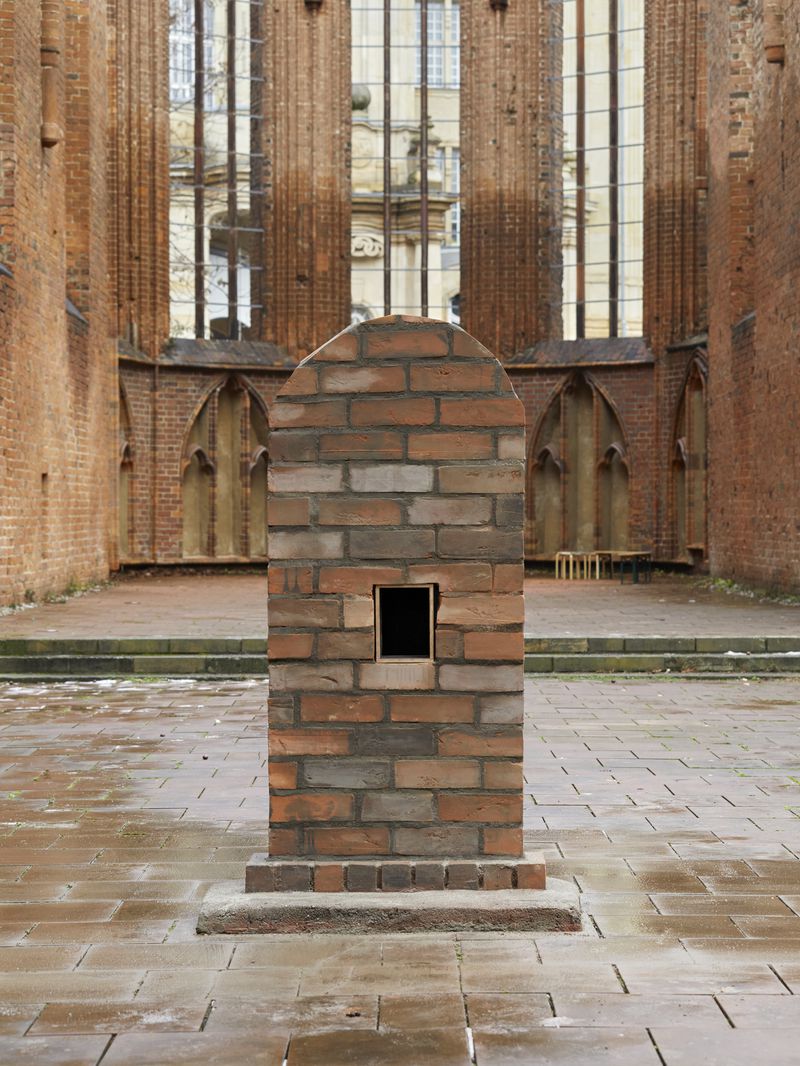
Installation view of Split nest, located at the entrance, 2024, bricks, mortar, wood, iron, sand, pigment
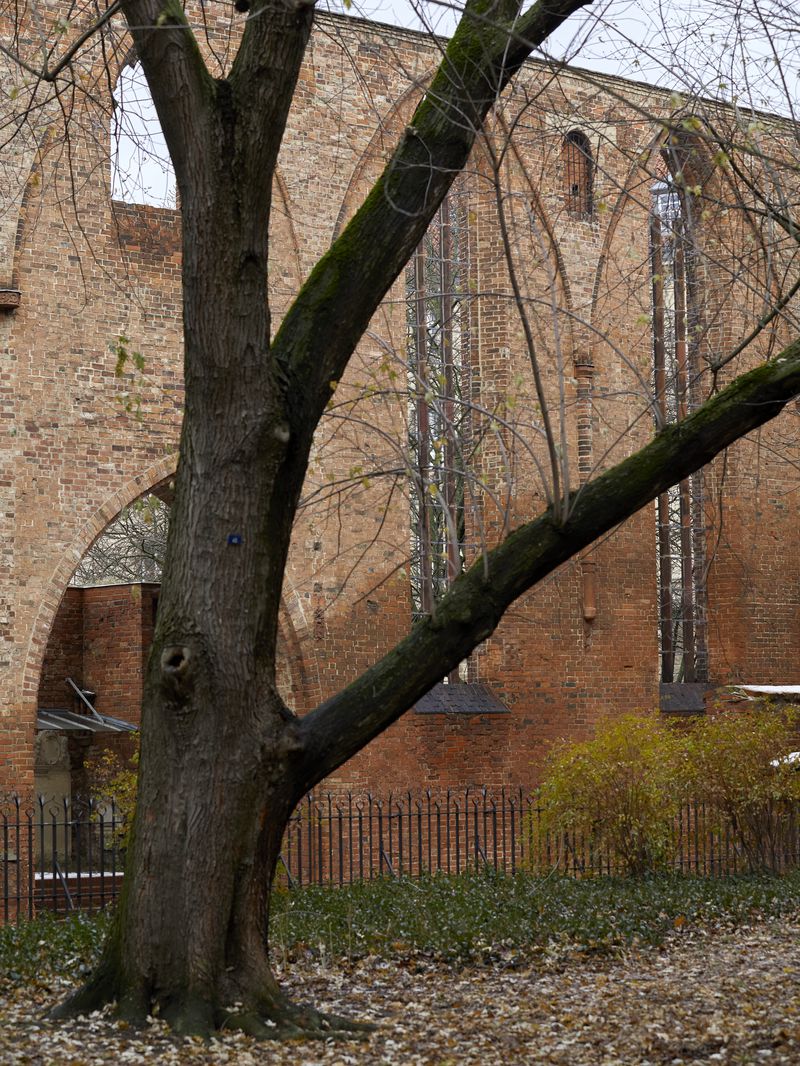
Installation view of Split nest, located in the monastery tower, 2024, bricks, mortar, wood, iron, sand, pigment
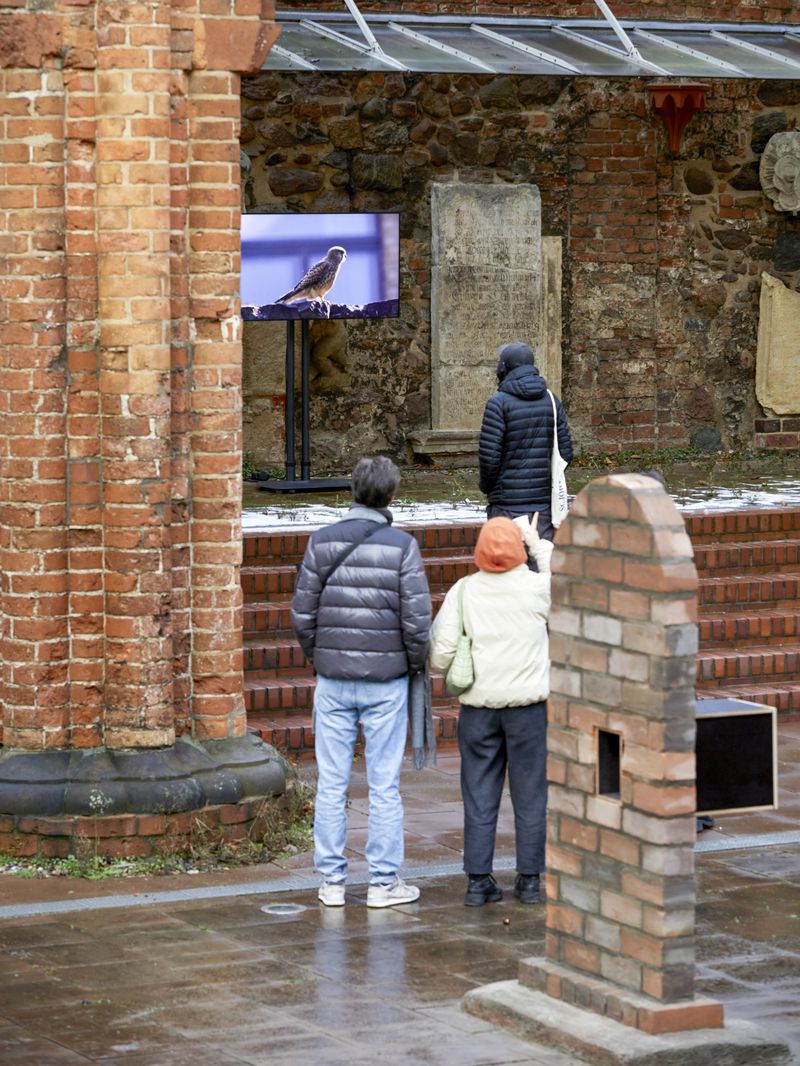
Installation view of whio whio (2020/21) and Turmfalke (2023), two comparative video studies of avian species in their respective environments
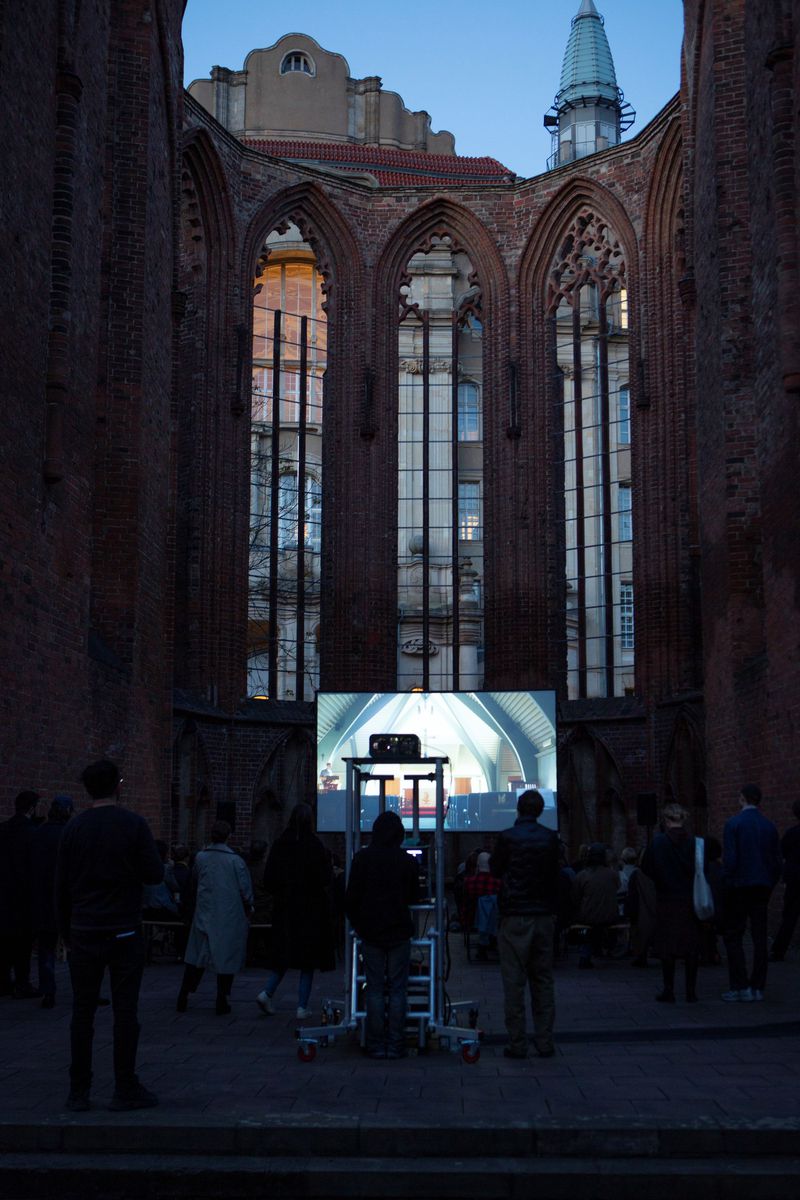
From the inaugural screening event of Nicky’s Conversion, 2024, Klosterruine. Image taken by Juan Saez
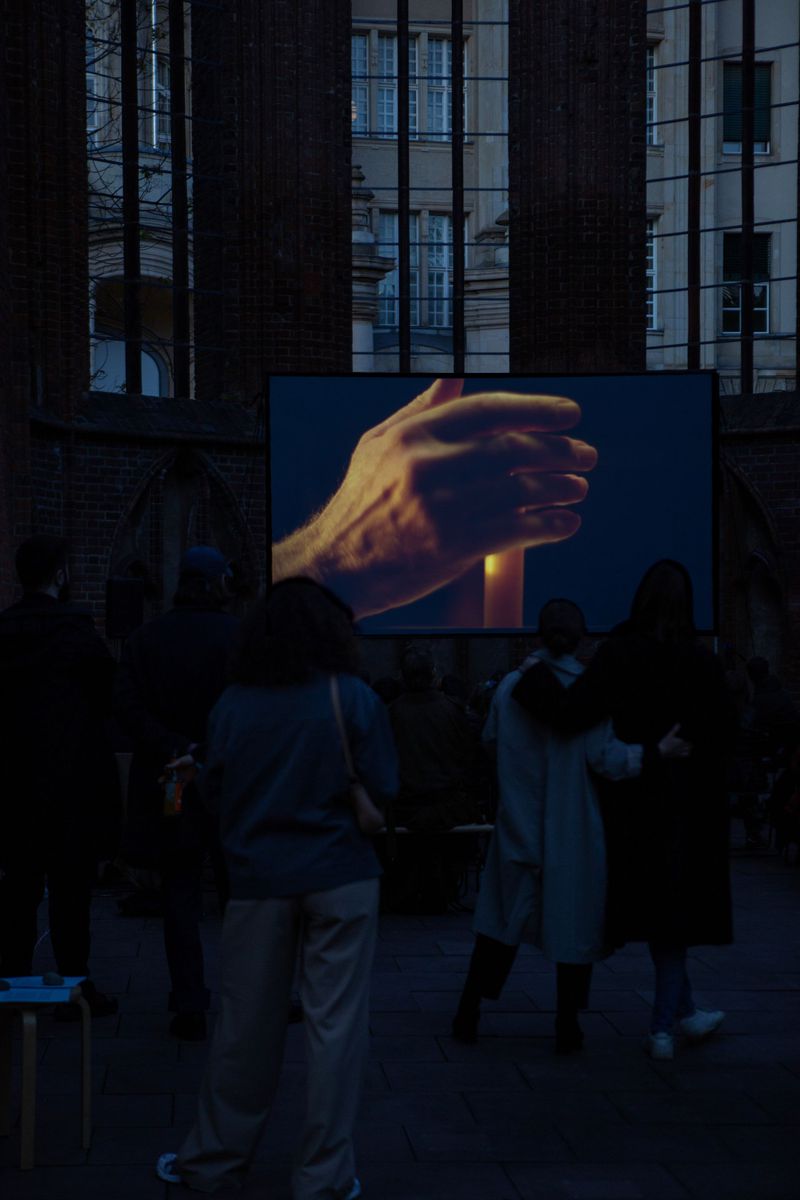
From the inaugural screening event of Nicky’s Conversion, 2024, Klosterruine. Image taken by Juan Saez
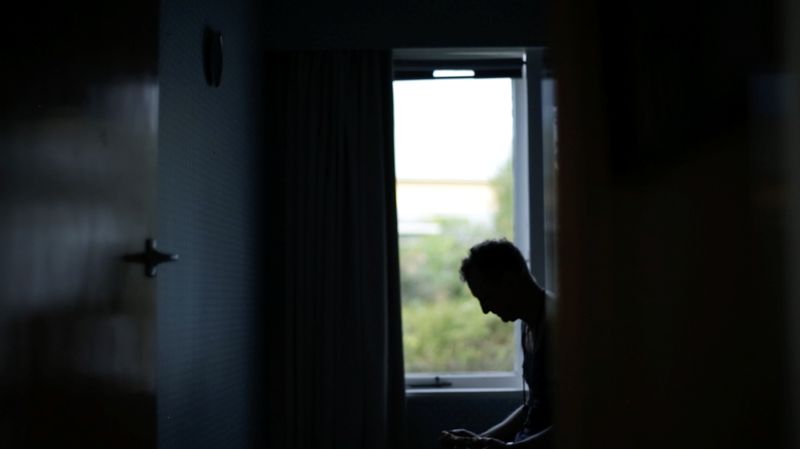
Video still from the film. Courtesy of the artist and Michael Lett Gallery
To notice the light changing.1
Arriving at the front gate to the Klosterruine – the remains of a Franciscan monastery and one of Berlin’s oldest existing structures, now open to the sky – between winter 2023 and spring 2024, visitors to Richard Frater’s exhibition What Remains of a Naturalist first encountered a freestanding brick wall with an arching top and a central aperture. This sculpture formed one part of Split Nest (2023), a sculpture composed of two identical parts.
The first part, installed in the main space of Klosterruine, opened onto a sand-filled wooden box. The second was positioned high above in the monastery tower, behind an open window and a black barred steel gate. Concealed and inaccessible, beyond the interior walls at the end of a spiral staircase, it remained largely unseen. The wooden boxes in both elements were modelled on nesting structures built for the Eurasian Kestrel, a cliff-dwelling falcon that has expanded its range through urban adaptation and is now widespread in Berlin.
Realized in December, the intervention anticipated the onset of spring, when birds begin to seek mates and nesting sites in preparation for the breeding season. Within the exhibition, Frater also presented whio whio (2020/21) and Turmfalke (2023), two comparative video studies of avian species in their respective environments. Across these works, he continues his long-standing inquiry into human–nonhuman relations, cohabitation, and ecological precarity – both in urban contexts such as Berlin, where gentrification and homogenization exert increasing pressure, and in remote environments rendered increasingly hostile through anthropogenic impact.
Nicky’s Conversion (2024) premiered at Klosterruine as part of this exhibition. Extending these concerns through an anthropological lens, the film addresses biological determinism and the constitutive role of cultural constructs. For the first time in Frater’s practice, these preoccupations are brought into direct relation with a human subject, marking a shift from the more abstract spatial logic of earlier sculptural and architectural installations – often aligned with expanded cinema and critical image practices – towards a time-based film form. The work unfolds as a portrait in duration, offering an entry point into an ongoing process of transition.
The film portrays Reverend Nicola Sian Frater – known as Nicky at the time of filming in 2020/2021 – as she navigates her gender transition while serving as an Anglican priest. It traces a process of acceptance and some of the difficulties of reconciling an interior sense of self with the external frameworks through which identity is recognized. It also reflects on how past experiences and relationships are reconfigured through personal transformation, shifting values, and changing social contexts.
Structured in two parts, Nicky’s Conversion deploys image and sound in distinct ways. In the first, Nicola Sian Frater rehearses a sermon: a preparatory act in which she shapes how she wishes to be seen, while preparing sacramental bread for Holy Communion. Within the sermon, she reflects on her gender journey, trans identity, and spirituality as they stood at the time of filming. In the second part, image and sound diverge to evoke a more interior register: seen through the threshold of a bedroom door, Nicky changes her clothing, while the film concludes with The Last Word, a song arranged for live piano and voice by the musician Abel Mercer, invited by Richard Frater. Its lyrics draw on the biblical story of the Syrophoenician woman (Mark 7:24–30), a narrative of persistence that challenges fixed boundaries of belonging.
Shot initially in 2020 and 2021 during Frater’s residency at Parehuia in Aotearoa, New Zealand, and later completed for its presentation in Berlin, the project spans multiple locations and temporalities. Alongside filming with Nicola, Frater recorded the whio (blue mountain duck), an endemic and endangered river-species, in the Ruahine Ranges. This material is later juxtaposed with footage of a kestrel that has nested inside the cavity of a chimney in an undisclosed apartment block in Berlin, and other sites like Tempelhof, where it circles, hovers and hunts above areas of public activity.
The whio study examines a bird now largely confined to remote and high altitude mountain rivers. While these environments appear to be its natural habitat, they offer no protection from introduced pests or growing destructive effects from global warming.2
Rather, these are simply the remaining clean rivers left, largely untouched by agricultural runoff and other forms of contamination. By contrast, the Turmfalke (kestrel) study explores a bird that has expanded its range through behavioural adaptations to the urban environment, where abundant food sources can outweigh other risks for some birds of prey.
Without an overarching narrative or monologue, details like social behaviors and environmental conditions are conveyed through montage and the juxtaposition of images – an approach that, in line with film theory, generates meaning through their sequencing. The works reflect on human impact and the adaptive strategies it compels for survival and continuance, from shifts in habitat and resource use to altered patterns of movement and cohabitation across species. By bringing together avian studies with Nicky’s Conversion, Frater links two fields of observation through a shared reflection of external impact and shifting notions of “naturalism.”
The presentation of Nicky’s Conversion at Klosterruine marks a pivotal moment in Richard’s practice, where engagement with the so-called natural world converges more explicitly with human relations. The site itself – a former place of Christian worship – provides a charged context for reflecting on belief systems, empathy, and the social structures that shape them. Founded in 1290, following the granting of land to the Franciscan order, the church architecture embodies historical contradictions itself. Francis of Assisi, its founding figure, is remembered for his devotion to poverty and his sense of kinship with all living beings. The legend of his sermon to the birds encapsulates this ethos and has been widely represented in art history. Giotto di Bondone’s fresco of St. Francis preaching to the birds3 – an image admired by both Richard and Nicola – suggests a point of resonance across differing yet overlapping systems of belief.
Nicola had long served as an Anglican priest at a vibrant retirement community. In a discussion following the film’s premiere, it emerged that the sermon shown in the film was part of her preparation for her public and professional coming out at Easter 2022, after which she retired early to be able to embrace her trans identity – a process which spanned at least eleven years for her. Alongside her ministry and human rights activism, she has worked extensively in dementia and palliative care, supporting individuals in navigating the transitions of aging, meaning, and loss.
In her rehearsal, Nicola reflects on a lifetime of inhabiting prescribed roles and the enduring impact of shame, particularly in relation to faith. Rather than rejecting the structures that shaped her experience, she interrogates their underlying values, asking for whom such systems are constructed, what norms they enforce, and how biological and cultural categories govern acceptance. Among these is the prohibition against cross-dressing, revealing an ideological resistance to the blurring of boundaries. Nicola’s name becomes an assertion of self, alongside motifs such as the driftwood she references and later holds, the preparation of bread as an embodied form of belief, the broken body within religious ritual, and the invocation of the Syrophoenician woman – a biblical figure who challenges established boundaries of belonging and prompts a reconsideration of accepted roles and stereotypes.
The notion of cross-dressing becomes a pivotal moment in the film. As Nicola changes from traditional male clerical attire – a grey shirt with a white collar – into a dress and necklace, the gesture marks both an intimate and symbolic rupture. The transition is underscored by Abel Mercer’s voice, sounding out a sense of passage and release. Frater approaches this moment with sensitivity, foregrounding the intersections of personal transformation, faith, and the evolving nature of identity. The commissioned music introduces an indirect dialogue that exceeds verbal articulation, approaching empathy as an attempt to draw closer to another while acknowledging that full understanding remains impossible.
At the same time, the work reflects on the relational conditions of its own making. While Frater remains outside the frame, his proximity to the subject is palpable. His camera enacts a form of empathy that does not collapse difference but instead renders visible the conditions under which a person comes to be seen. It preserves the possibility that empathy itself can generate critical distance, or, as Harun Farocki has noted, “to empathize in such a way that it produces the effect of alienation.”4 Through this balance of proximity and distance, Frater’s film seeks, in his own terms, “to produce a compassionate encounter with non-coercive love.” 5 As in his studies of birdlife, the camera operates as a tool for revealing both the implications of institutional frameworks, ecological and social – while exposing the instability of categorization.
By bringing together ecological observation, spatial intervention, and narrative film, Richard bridges previously distinct strands of his practice. In doing so, he foregrounds an attentiveness to the fragility and significance of life processes, opening a space in which human and nonhuman, personal and systemic, are understood as deeply entangled.
1 Taken from Sacrament No. 22 from Paul Thek’s 96 Sacraments (1975), a handwritten text originating from Notebook no. 75; see Stephen Fowler, “Paul Thek’s 96 Sacrements: Praise the Lord” (accessed 25 May 2026).
2 Various groups that support the whio populations are largely focused on maintaining traplines and reducing populations of introduced pests such as stoats and rats.Working within conservation networks, they include hunter guilds, hiking societies, grassroots initiatives, hapū, energy companies, and government-funded organisations.
3The depiction of the Sermon to the Birds forms part of the iconic fresco cycle by Giotto di Bondone in the Basilica of Saint Francis of Assisi. The frescoes, narrating the life of Saint Francis, were painted around 1297–1300, a timely coincidence with the construction of the monastery church in Berlin.
4 Harun Farocki (2008): “Einfühlung (Empathy),” translated by Michael Turnbull, in: 100 Jahre Hebbel Theater. Angewandtes Theaterlexikon nach Gustav Freiytag, ed. by Hebbel am Ufer, Berlin, p. 22.
5 E-Mail correspondence with the artist on 19 October 2022.