ART UNION
Thursday 19 March 2026 - Saturday 2 May 2026
Win a major painting by Judy Millar
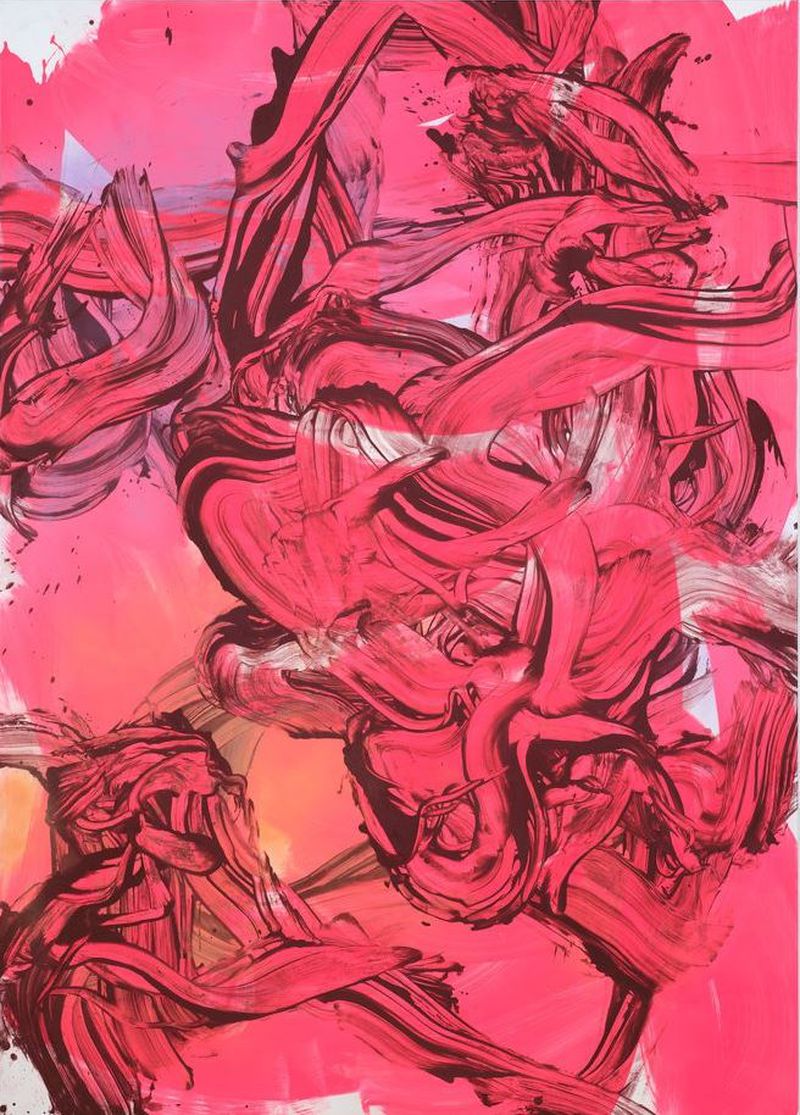
Win a major painting by Judy Millar
Buy your ticket now
To mark 20 years of the Parehuia Artist Residency, McCahon House presents the Art Union, a nationwide raffle where art itself is the prize.
One participant will win Judy Millar’s Hard Epic (2021), a painting generously donated by the artist.
Millar was the first artist to undertake the Parehuia residency twenty years ago and now serves as a trustee of McCahon House. Her donation celebrates the residency’s anniversary while supporting the artists who will follow.
Art Unions have a long history in Aotearoa, using art as the prize to fund projects that benefit communities. This Art Union continues that tradition by supporting the future of the Parehuia Artist Residency.
1,000 tickets available
$100 per ticket
Fundraising target: $100,000
Tickets are available now through our raffle platform. See link at top of page.
The winning ticket will be drawn 11:30am, Sunday 3 May 2026, on the final day of the Aotearoa Art Fair at the McCahon House booth.
All funds raised will support the long term sustainability of the Parehuia Artist Residency, ensuring artists continue to receive the time, space, and support needed to develop their work.
Hard Epic (2021) is an acrylic and oil on canvas by Judy Millar, measuring 2100x1500x35mm
Passing It Forward at Parehuia
In the life of an artist, timing can change everything.
Sometimes, the right moment arrives, when the artist is ready, when opportunity opens a door, and when the conditions suddenly exist to allow a leap forward.
For Judy Millar, that moment came twenty years ago in Titirangi. She became the first artist to live and work at Parehuia, the new purpose-built residency beside the former home of Colin McCahon.
The house was new, the programme still finding its shape, but what it offered was rare and unmistakable: time, space, and the freedom to focus entirely on her work.
“My residency at Parehuia came at a crucial time for me,” Millar recalls. “I had taken a number of decisions that allowed me to make a greater commitment to my work. Those decisions had at the same time made my financial position more precarious.”
Residencies are often described through their practical components. A place to stay. A studio. Time away from daily obligations. But what they offer artists is something more difficult to secure: the conditions in which laser sharp focus becomes possible.
“Being at Parehuia allowed me to relax about the financial challenges I was facing and to concentrate on the important task at hand.”
The setting carries its own gravity. Parehuia sits beside the modest house where McCahon once lived and worked, a place where he grappled with many of the same uncertainties artists continue to face today. During her residency, Millar felt that presence keenly.
“I felt strengthened and encouraged,” she says. “It was as if, late at night, McCahon himself would come and tell me ‘get serious, move forward’.”
Experiences like that tend to reveal their meaning only in retrospect. What begins as a temporary moment of support often becomes part of a much longer trajectory. Two decades later, Millar has returned to that beginning with a gesture that carries its spirit forward.
To mark the twentieth anniversary of the Parehuia Artist Residency at McCahon House Trust, Judy Millar has donated a major painting from her studio, Hard Epic (2021). The large, energetic canvas forms the centrepiece of the McCahon House Art Union. Through a public raffle, one participant will receive the work while ticket proceeds support the future of the residency programme.
Now a trustee of McCahon House Trust, Judy Millar sees firsthand how vital the residency remains for artists working in Aotearoa today. Her decision to donate the painting reflects a belief that artistic communities endure through acts of reciprocity. Artists are sustained not only by institutions or funding bodies but by one another, through gestures that allow the next generation to step into the same conditions of possibility.
“I’m now in a position to give back and help support other artists. I have been given so many opportunities over the years and I want to see other artists be given similar chances.”
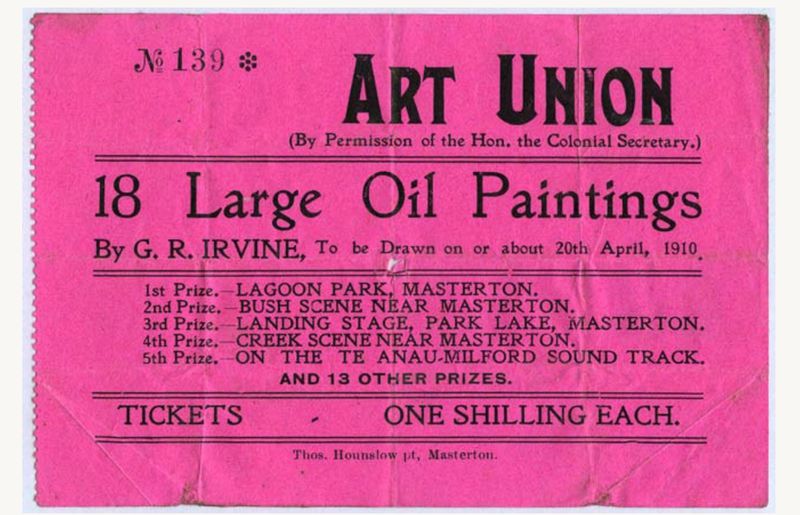
The form this gesture takes carries its own meaning. Rather than a conventional fundraising campaign, the project revives the idea of the Art Union — a historic model in which the prize itself was a work of art, most often a painting, and the proceeds from ticket sales funded projects that would benefit communities.
“A raffle invites everyone to participate,” Millar says. “It allows anyone to buy a ticket, join in, and collectively build the work of McCahon House into the future.”
Throughout much of the twentieth century in Aotearoa, Art Unions were a popular way to raise funds for civic infrastructure, sporting facilities, and cultural initiatives. The principle was simple but powerful: people bought tickets for a chance to win a painting, knowing that the money would support something larger than the individual prize. The name “Art Union” highlighted the centrality of the artwork itself and distinguished the practice from gambling, framing it instead as a collective investment in community.
“I was fascinated to learn that the first lotteries in Aotearoa were the Art Union raffles which offered paintings as prizes,” Millar recalls. “Funds generated helped support community projects.” Over time, the shift away from art as the prize seemed to reflect broader changes in cultural priorities. “The fact that paintings were in turn replaced by gold nuggets and then finally cash prizes also speaks to different values coming into play.”
For McCahon House, returning to this original idea felt significant. “The history of gambling in our country is a colonial and problematic story,” Millar reflects, “but to reclaim it, to take it back to the raffle of a painting in order to support our own communities seems like a perfect response.”
In her view, the initiative is about more than fundraising. It is about recognising the fragile networks that sustain artistic life — the acts of generosity, the shared commitment, and the structures that allow artists to thrive. Through the Art Union, each ticket becomes both a chance to win a painting and a way to sustain a community of support that has nurtured generations of artists.
“I’m a firm believer in the art ecosystem,” she says. “As an artist who can now help support others, I’m eager to step up and see other artists be given opportunities to flourish.”
“Our arts communities are less and less able to rely on government support. We need to be proactive if the programmes that help our scene flourish are to remain in place.”
At the heart of that effort is Parehuia itself. The residency offers artists a rare combination of time and space — a pause from the pressures of everyday life that allows them to step fully into their own ideas and aspirations. Within this environment, the house nurtures the possibilities artists hope to explore, providing support that turns potential into action.
“Culture is a conversation. It shifts, changes, mutates, and challenges. None of this happens without support, nurture, and an awareness of what’s come before alongside a desire for the new,” Millar explains.
Residencies like Parehuia are the engines of that conversation. “The programme is an incubator. It helps artists grow,” she says. Over two decades, it has supported painters, sculptors, installation and moving image artists, and research-based practitioners — many of whom now have national and international careers, forming a community of alumni whose work continues to shape Aotearoa’s cultural landscape.
Millar has seen this impact firsthand. “I have seen how the Parehuia Residency lifts artists up. It is essential the programme remains strong for future generations.” For her, its significance is both practical and symbolic. “Our small but vital art scene needs Parehuia. It’s a lighthouse project that has generated new possibilities and is a marker of excellence.”
A lighthouse does more than illuminate what already exists. It guides what is still approaching. The artists who will arrive in the years ahead have yet to appear. Their ideas are still forming. Their work is still uncertain.
The McCahon House Art Union is an invitation to be part of that future. By purchasing a ticket, participants join the chain of support that has sustained artists for generations. Like the early Art Unions that helped build public spaces across the country, it rests on a simple belief: many small acts of participation can create something enduring.
In this case, it begins with a painting, and with the hope that the next artist to arrive at Parehuia will find the same rare gift Judy Millar once did: time, space, and encouragement to move forward.